Quadrature – The Raga Massive Jam Sessions
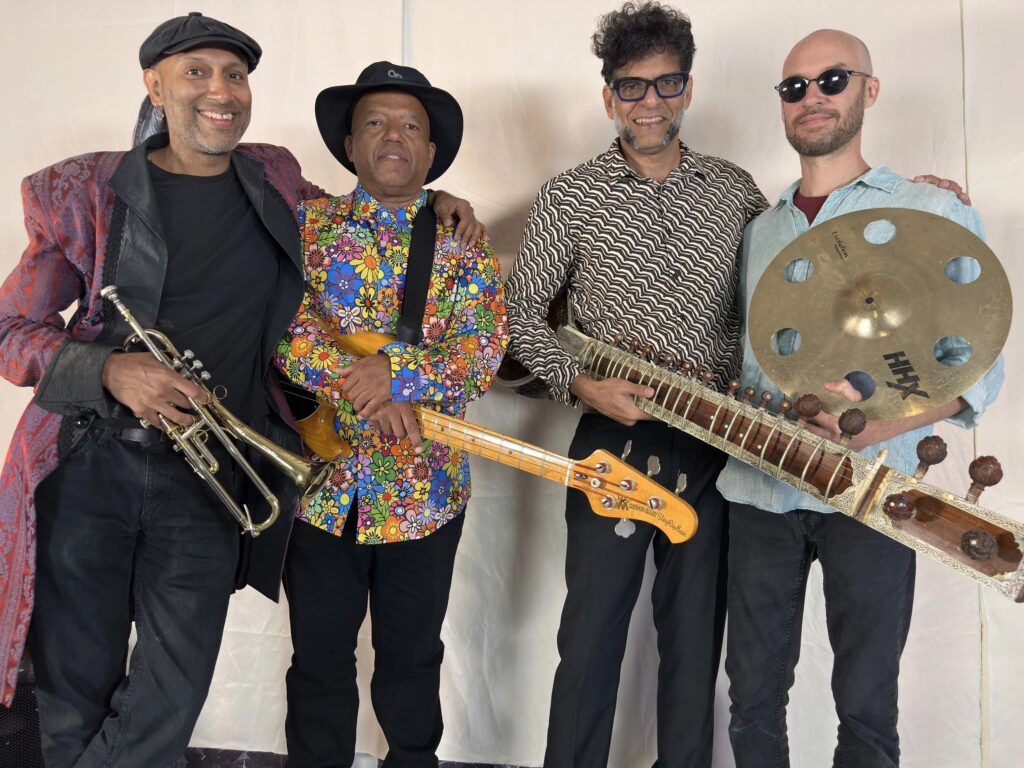
1. Quadrature emerged from the Brooklyn Raga Massive jam sessions. How did those fully improvised street and jam performances shape the band’s chemistry and long-term musical direction?
Satish: I think the most important thing to come out of the jam session nature of our initial performances is the idea of group improvisation and composition. This differs from a “top down” approach where a single bandleader writes all the music and dictates the sound of the ensemble. Quadrature’s sound is very much a democratic product, and many of the songs are either composed by multiple group members, or we have arrived at the final arrangements through active participation of all the group members.
2. Your music blends raga, rock, jazz, and psychedelia in a way that feels both rooted and exploratory. How do you balance honoring deep musical traditions while pushing into uncharted sonic territory?
Satish: In a general sense, Neel’s and Tripp’s experience in Hindustani playing grounds us in North India’s musical traditions while the rest of us try to pull us away! 😂
Neel: Myself and Tripp have the most experience in raga music. We played sitar and tabla together for years before starting Quadrature, but we all have decades of experience in multiple genres and a history of exploring uncharted territories. It feels only natural to create new forms amassing lifetimes of knowledge. We create the music that we want to listen to.
Satish: My musical history, at least since moving to NYC in 1996, has been nothing but exploring uncharted territory! This is evidenced in my hybrid valve/slide trumpet, my use (some may say overuse!) of effects, and the history of ensembles I’ve been in. Although I’ve never formally studied either Hindustani or Carnatic music, I’ve picked up a bit here and there through informal lessons, so that small part of my brain does pull me back into the traditions.
3. The name Quadrature has roots in mathematics and astronomy, described as “the area under the curve of raga and contemporary music.” How does this concept translate into your compositions and improvisations?
Satish: I’ll let Neel address this question, apart from pointing out that we love sonically portraying a black hole’s swirling gravity!
Neel: Quadrature has several meanings. In mathematics it was an old term for the area under the curve. In astronomy it represents the position of the moon or a planet when it is 90° from the sun as viewed from the Earth. It also happened to be the name of a setting on my effects pedal! I have a layperson’s interest in astronomy and astro-physics so our name is a nod to all of that. Mathematically speaking we naturally gravitate to all sorts of time signatures, including, 7, 9, 10 and more, with only one piece on the album in 4. In a larger sense we try to take listeners on a journey and while we are influenced by traditions from around the world, we leave ourselves free to move beyond the Earthly confines, the uncharted territories.
Satish: I got a new effects pedal a couple of months ago that has a setting called “Black Hole”, and it actually works perfectly on Black Hole Blues! 😁 (But you gotta come to a live show to hear it, I got it after the album was recorded).
4. Early on, the band focused heavily on improvisation rooted in ragas. How has your approach evolved when translating that live, spontaneous energy into structured studio recordings?
Satish: It’s true that early on, we were playing a lot more traditional Hindustani raga form. You can still hear that in songs like Charukeshi Constant on the album, and Redshift Blues from our live shows. These songs have very short melodies and emphasize improvisation on the raga. Later on, we started to write songs that focus a little more on the melodies, a bit like a Western pop song. Take for example Morning Time which has a few distinct sections that could almost be thought of as “verses” and “bridges”. Right now, I think we’ve found a good blend of raga-based improvisations and song forms. Could this change in the future? I certainly hope so! (And who knows how it’ll change! 😁)
5. Black Hole Blues is your debut album. What does this title represent musically and conceptually for the band?
Neel: The lyrics to Black Hole Blues (the only vocal song in the album) represent a poetic take on Einstein’s general theory of relativity. He said that heavy gravity slows down time. Our conceptual take is that the gravity of the moment also slows down time for us individually in heavy times, as well as when we consciously use sound and focused attention to bring healing in the moment. Perhaps in a larger sense, using this title for the album is a reminder that while we are stuck in the struggle of these crazy times here on Earth, it is still insignificant in the cosmic scale. And we love to sonically portray a black hole’s swirling gravity. Watch our video for Black Hole Blues to see these concepts (and more) brought to life visually! You have to watch to find out if we survive the black hole!
6. Neel, you’ve mentioned that electrifying the sitar significantly changed your sound. How did that evolution influence the overall sonic identity of Black Hole Blues?
Neel: After decades of preferring a largely acoustic sound, in the last 5 years I have been exploring an electric sound with a number of effects as I expanded my palette and embraced the sounds of the rock music I loved growing up. This electrification affected the vibe, energy and attitude of the band more than just the sound. I have always played sitar seated traditionally on the ground or a bench. To keep up with the rock influenced vibe we were creating, I had to invent a sitar stand so I could stand up and join the band in fully rocking out!
Satish: Among the band, we now call Neel’s instrument a “STAND-tar”! 😂
7. Satish, you’ve spoken about wanting to capture the feeling of your live musical conversations in the studio. What techniques or mindset helped you preserve that live energy during recording?
Satish: Our recording was really just a live performance that we meticulously recorded. Unlike the majority of albums recorded these days, we did not record each instrument separately, nor did we use a “click track” to keep everything in strict time. Instead, we all recorded at the same time, embracing any minor “mistakes” we may make, and preserving the nervous energy that comes from the sense that whatever comes out of my instrument right this second is what’s going to be preserved for eternity! 😁
8. The band features a unique instrumental lineup—electric sitar, Firebird trumpet, rhythm section, and effects. How do each of these voices find space within the mix without overwhelming one another?
Satish: I’ll speak from my perspective specifically. Since I play one of the two acoustically loudest instruments in the band (the other being drumset), I have to consciously check myself to make sure I am not drowning everyone out and giving everyone equal room to express themselves. That goes double for when I kick in my effects, especially because I love sending my delay trails into self-oscillation, which ALWAYS overwhelms the band! I have to make sure those moments are rare and well-timed so that they don’t distract from the overall sound of the music.
Neel: The craziest sounds on the album are from Satish. My effects hovered around standard sounds of chorus, delay, wah and distortion. Playing live we have to be sensitive enough to not overwhelm with the effects, but pick our spots and create that psychedelic sound. The album was mixed by our drummer Tripp. As a member of the band he was finely attuned to the balance of sounds needed to let each shine.
9. Your performances span venues from Globalfest at Lincoln Center to street performances in Brooklyn. How does the setting influence the way Quadrature performs or improvises?
Satish: There are many factors that change our performance based on the venue, but I think one that is very important doesn’t have to do with the venue itself per se, but rather how much time we are allotted for our set. For example, at Globalfest we had a pretty short set, so we had to not only program our songs to have the maximum impact, but we also had to be conscientious about not stretching out too much during our solos. Keep everything short and sweet and to the point. In fact, we often have one song on the setlist that is the “if there’s time” song … when we get to it, we check the clock and cut it if we’re nearing the end of our timeslot!
Neel: I’ll just add that In our early days of playing a few low pressure street performances and jam sessions we felt really free to explore and find our sound with long improvisations based on ragas. As we graduated to larger venues, it was only natural to evolve our sound with shorter tunes, stricter arrangements and breaks, while still leaving room to improvise and vibe.
10. Now that Black Hole Blues is being released through Deko Entertainment (ADA/Warner Music Group), how do you see this debut shaping the next phase of Quadrature’s journey—both live and in the studio?
Satish: We’re already thinking about our next release! We have enough unrecorded songs to fill about half of a new album, so we will be writing more songs as soon as we can. Also, we’re very excited to see how our relationship with Deko can help us get onto the festival circuit or college circuit. Now that we have an album to promote we’ll definitely be performing and touring more!
Neel: We can’t wait to build off the visibility of this album and music video to tour and record the next one!