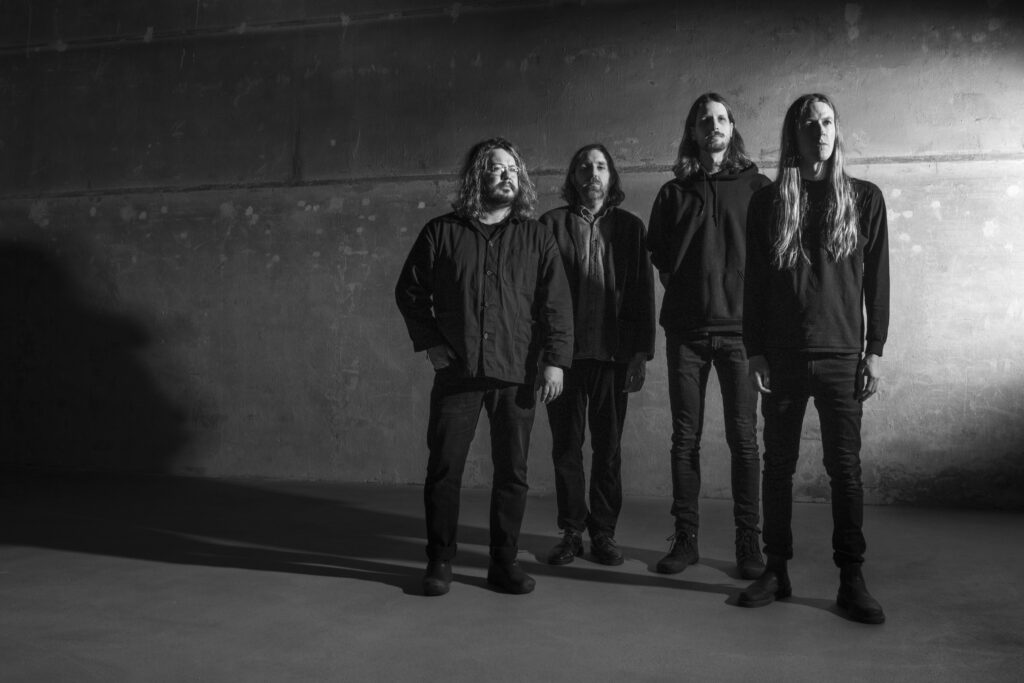
Through Zero is described as one of your most immediate and engaging records, what changed in your creative process to achieve that balance between accessibility and complexity?
We often write music first for the studio and don’t think so much about the live aspect until later on. With this album, there was a conscious decision to write songs that would also translate well to the stage. I think this set us up to write more sections that are ‘in focus’ immediately, rather than requiring multiple listens to untangle.
You’ve built a reputation for blending multiple genres without losing your identity, how did you approach incorporating “outside the sphere of rock” influences on this album?
It often takes a few revisions until we’ve figured how to integrate new sounds into the music without the experience being jarring or sounding out of place. More than that, I can’t say. It has to feel natural, and when it does, we know we’ve made it work.
The concept of “through zero” comes from engineering, how did this idea shape the songwriting and thematic direction of the record?
The album title came after the songs were written and recorded, as it sometimes happens. I find that often a unifying theme or title isn’t apparent until the record is finished.
Nick, you mentioned that life’s extremes exist along the same “signal path”, how do these philosophical ideas translate into the music itself?
Our music is quite dynamic, many mood shifts occur within each song, and I think every Elder song is a little journey in itself. I’m not sure if the music and these themes can really be equated, but they complement each other.
This is the first album you’ve both produced and co-mixed with Richard Behrens, how did that deeper involvement impact the final sound?
Having a greater influence and control over the mixing of the record means that we got closer to our vision for the album’s sound than ever before. This is in my opinion the best sounding Elder record to date!
Recording in Berlin over several months between tours sounds intense, did that fragmented process influence the album’s flow or cohesion?
It was intense and sometimes stressful, but we found that, ultimately, having time to take breaks and reflect upon what’s been done and what needs to still be done was helpful. We also used the time in between sessions to work on (pre)mixing and I think having the recording time span last several months as opposed to a few weeks ultimately gave us the most mature record so far.
After nearly two decades as a band, how do you continue to evolve without repeating yourselves or falling into familiar patterns?
At this point, Elder doubtless has its own immediately recognizable sound and identity. One has to be honest with oneself when writing new music: is this something truly new and worthwhile, or just a repeat? It’s not a question there is always an easy answer for. We just try to remember that the main goal when writing music is to express ourselves and be honest.
Tracks like “Capture/Release” and “Strata” suggest movement and transformation, are these titles connected to the album’s broader themes of cycles and non-linear journeys?
Neither of these songs directly has to do with movement or transformation in that sense, but even the fact that the music itself gives that impression is a good sign. Capture/Release is about reclaiming autonomy in the act of creation – as opposed to being forced to create for money. And Strata explores our connection to the dead and our own mortality.
Your music is known for its hypnotic grooves and progressive structures, how do you balance technical complexity with emotional impact?
Our strategy is to write music that is emotionally impactful, but also unique and engaging. Often that means that we take ideas that might otherwise be simple and twist them until they are also surprising, progressive, unpredictable.
Looking back at your journey from a small town in Massachusetts to becoming leaders in heavy psychedelic rock, how does Through Zero represent where Elder stands today, and where you’re headed next?
We don’t know where we’ll go from here, and it’s always very difficult to say that when a new record is just released. It feels like a massive act, and it’s exhausting. First we’ll go play some shows and then see where we land. After 20 years it’s not easy to see the future, it feels like we’re in the future we imagined when we started. Complicated.